Posting at Scale Without Getting Blocked: Pacing, Variety and Original Content
How agencies publish to dozens of accounts without restrictions: official APIs, staggered pacing, original content per account, and the networks' own rules.
7 min read
If you manage dozens of accounts, you know the scenario. A campaign goes out to every page, and a few hours later there's a restriction notice, posts that vanished from the feed, or an account asking for verification. The first instinct is usually to look for a trick to get around the system. That instinct is exactly what leads to the next block.
The networks aren't fighting agencies. They're fighting spam, inauthentic behavior and duplicated content, and high-volume publishing can look similar from the outside. This article is about looking like, and being, what you actually are: a business publishing legitimate content on behalf of real clients.
What the networks call spam
Before talking about pacing and tools, read the rules themselves. Meta lays out restricted behavior in its Community Standards on spam, and YouTube explains what counts as spammy or misleading in its spam, deceptive practices and scams policies. These documents change from time to time, so revisit them before a large campaign.
The common thread across most of them:
- Identical or near-identical content distributed repeatedly, across many accounts or within one
- Artificially driven engagement: likes, comments or shares that don't come from genuine interest
- Misleading destinations: links that lead somewhere other than what the post promises
- Automation outside permitted interfaces
Notice that none of these forbid an agency from managing many accounts. They forbid specific behavior.
Principle one: official interfaces only
The single biggest risk reduction is publishing only through each network's official API, with permissions the account owner explicitly granted.
Why it matters
- The network knows who is posting. A post from a registered, reviewed app is identified as such. A post from an automated browser on a shared IP, logged into dozens of accounts, looks exactly like bot activity.
- No password sharing. The client grants access, can revoke it at any time, and never hands a password to anyone.
- Limits are transparent. Official APIs have documented rate limits and quotas. Meta documents the per-account cap on API-published posts in a rolling 24-hour window in its Instagram content publishing guide, and YouTube lists the quota cost of each API operation.
Tools that promise "unlimited posting" or work by impersonating a user in a browser may save time in the short run, but they put your clients' accounts at risk.
Principle two: original content per account
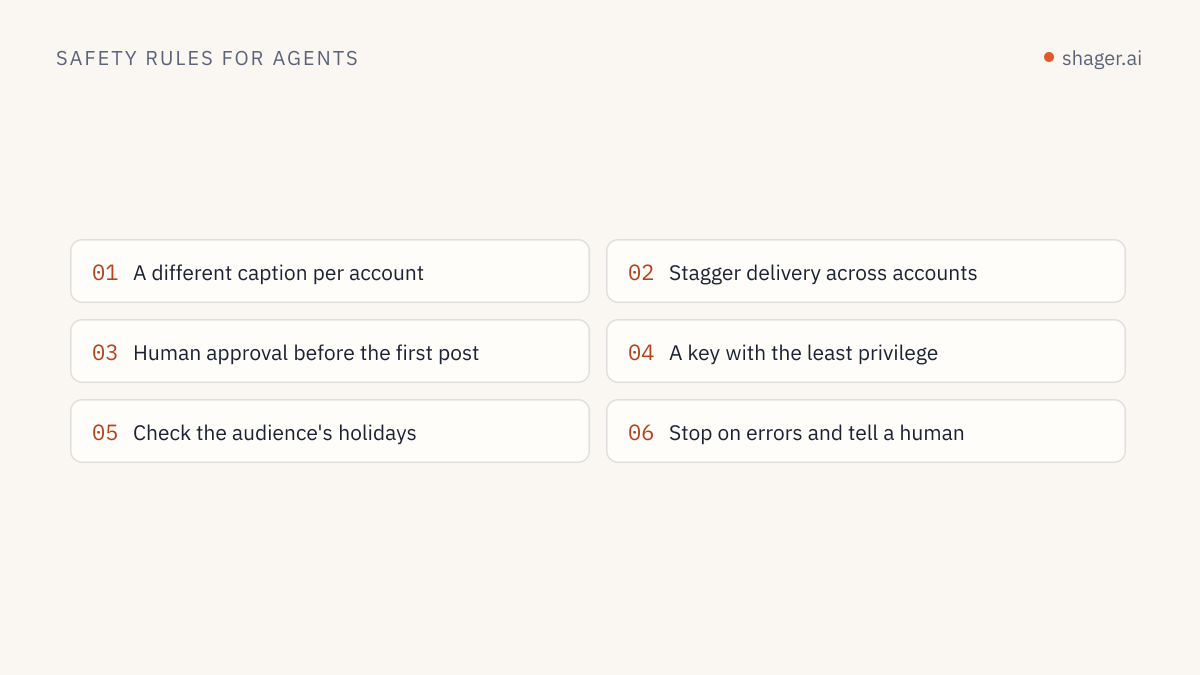
This is the most important principle and the most tiring. The exact same text with the exact same image across dozens of pages is the classic pattern spam systems look for, even when every page belongs to the same client.
What counts as "original enough"
There's no numeric threshold, and you shouldn't go looking for one. The right question is: was this post written for this account's audience?
Practical ways to get there:
- A different opening per account group
- A real local detail: the location name, a neighborhood, a local event, a staff member
- Varied visuals: several images or video cuts, not one file for everyone
- A differently worded CTA
- Not every post for every account: if a location isn't part of the promotion, it doesn't need the post
AI writing assistants can produce variations quickly. They help when they genuinely change the content, not when they just swap in synonyms. A variation that differs by a few words is still a duplicate.
Principle three: staggered pacing
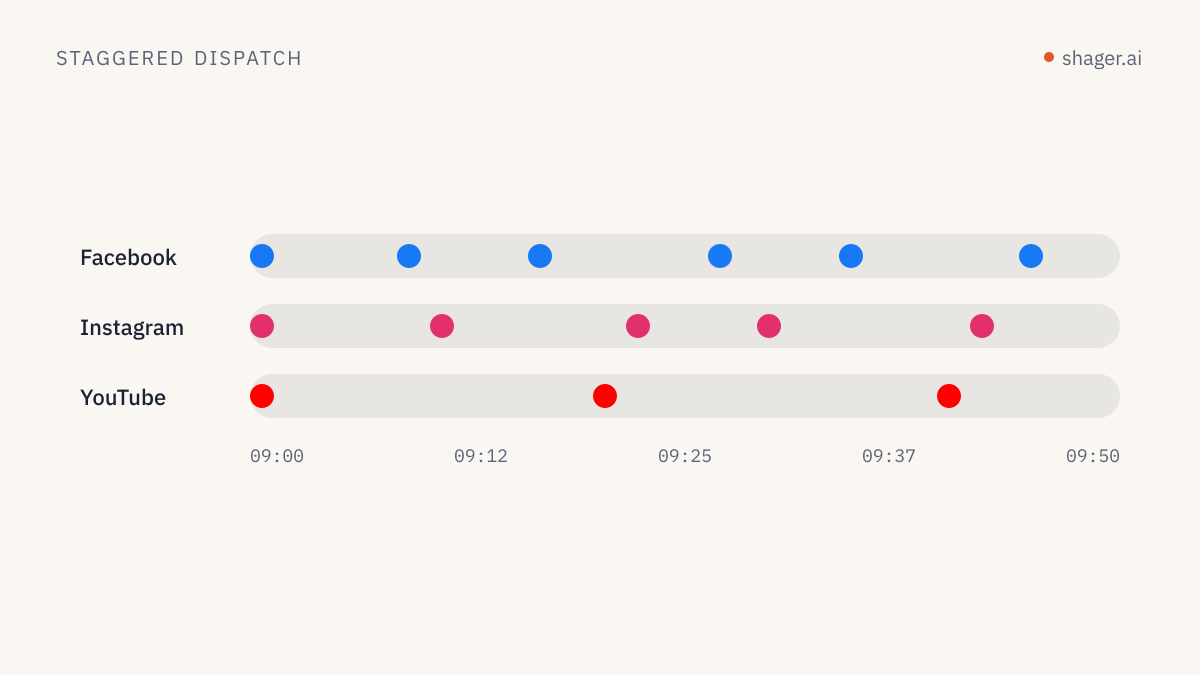
Even original content creates an unusual pattern if it goes out to fifty accounts in the same second. Spreading it over time is a simple way to look like what you are: a team publishing for different clients.
Scheduling rules of thumb
- Spread one campaign across several hours, and larger campaigns across a day or more
- Use variable gaps between accounts rather than exactly one post per minute
- Respect the per-account limit and your app's overall quota. As you approach them, defer publishing rather than retrying
- Treat errors as signals: if the network returns a rate-limit or restriction error, stop and slow down instead of retrying immediately
Principle four: genuine engagement only
Some blocks don't come from publishing at all, but from what happens afterward. Avoid:
- Pages of the same client systematically commenting on and sharing each other's posts
- "Tag three friends" or "comment YES to get it" prompts designed to inflate engagement
- An identical first comment with a link posted word-for-word across every page
- Short links that hide the destination or lead to an unrelated page
A first comment carrying a link is perfectly legitimate. It should meet the same standard as the post: varied, relevant, and leading where it says it does.
When an account gets restricted anyway
- Stop publishing to that account. Don't try to work around it.
- Read the notice. It usually states the general reason.
- Review recent content against the rules: duplication, links, wording.
- Appeal through the official channel if the restriction looks wrong.
- Update your process so it doesn't happen on other accounts.
Checklist for publishing at scale without blocks
- Every account is connected through an official API with the owner's authorization
- No password sharing and no browser automation
- Each account group has its own wording and visuals
- Every post carries a local or relevant detail
- Publishing is spread over time with variable gaps
- Per-account and per-app limits are known and respected
- Rate-limit errors pause publishing instead of triggering immediate retries
- No artificial engagement between a client's own pages
- Links go exactly where the post says they go
- Someone on the team has read the networks' policies in the last few months
Wrapping up
There's no trick that lets you publish at scale without getting blocked, and you don't need one. What works is the combination of official interfaces, content written for each account's audience, pacing that respects the limits, and genuine engagement. It takes more effort than copy-paste, but it's also what produces results, because audiences respond to content that speaks to them.
Shager is built on these principles. It publishes only through each network's official API, staggers dispatch at a pace that respects each network's and each account's limits, and its AI writing assistant produces genuinely different variations for each account group, so every page gets content written for it.