Keeping One Brand Voice Across Dozens of Social Accounts
How agencies managing dozens of pages and profiles keep one consistent brand voice without duplicating posts: style guides, templates, groups and QA.
6 min read
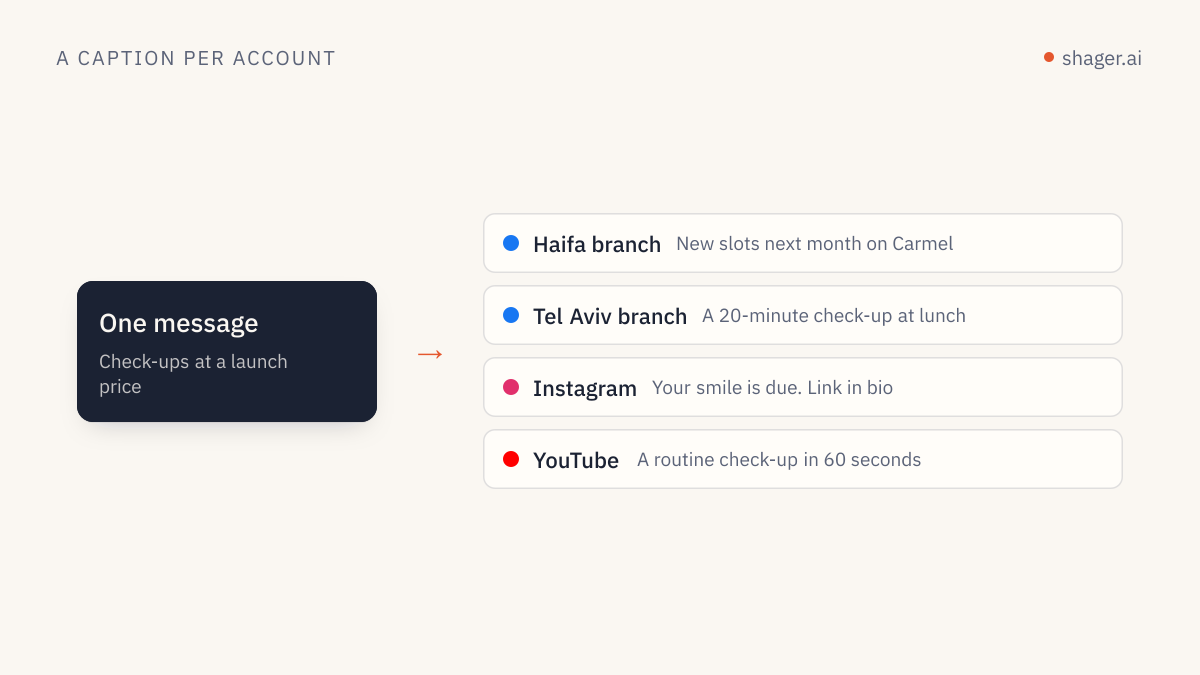
With one account, brand voice lives in the head of whoever writes the posts. With thirty franchise locations, twenty dealer pages or fifty profiles across a holding company's brands, it can't live there anymore. Every writer brings their own habits, every client asks for "one small tweak," and a few months later the pages sound like five different businesses.
The common shortcut, pasting the same post into every account, causes a different problem. Identical content across dozens of pages looks lazy to the audience and can hurt distribution. The goal isn't identical text. It's an identical voice. This article is about the difference between the two, and how to build a process that holds it in place.
Voice is not a text template
Brand voice is a set of decisions: how you address people, how formal you are, which words you use and avoid, how much humor is allowed, what a call to action sounds like. Two posts can share no sentences and still sound like the same brand. Two nearly identical posts can feel off if one was written in a rush.
It helps to separate three layers:
- Voice: fixed at the brand level. It doesn't change between accounts.
- Message: fixed at the campaign level. Same offer, same core benefit, same proof point.
- Wording: varies by account, network and audience. This is where the city name, the location manager, a local detail or a different angle goes.
Once your team sees these layers clearly, you can produce variations without losing the identity.
A style guide people actually use
Most brand books are written once, exported to PDF and forgotten. A useful guide for an agency publishing at volume is short, practical and available at the moment of writing.
What it must cover
- Form of address: "you" and direct, or more distant? First-person plural for the brand, or third person? Decide once.
- Formality: one example of a sentence that is "us" and one that isn't beats a page of adjectives.
- Preferred and banned words: "customers," not "consumers"; "price," not "attractive pricing."
- Length and structure: lines before the CTA, lists or no lists, emoji policy.
- Approved calls to action: a closed list of three to five phrasings. This is where brands drift fastest.
- What you can't promise: prices, outcomes, or claims the client's industry or regulator won't allow.
Where it should live
Not in a shared drive. Put it where the post gets written: as a pinned note in your scheduling tool, inside the template, or as standing instructions for your writing assistant. If people have to go looking for the guide, they won't read it.
Templates with variables, not copy-paste
When one campaign goes out to dozens of accounts, a template with variables balances consistency against variety. Instead of one block of text, you write a fixed structure with slots:
Open on the audience's problem → core campaign benefit → local detail (city, location, manager's name) → CTA from the approved list
Every post comes out different enough not to read as a duplicate, while the structure and tone stay the same. Prepare two or three alternative openings per campaign and rotate them across accounts.
What to avoid
- Swapping only the city name and leaving the rest identical. That's still duplication.
- Letting every writer "improve" the template freely. Small improvements add up to drift.
- One template for every network. A Facebook Page post, an Instagram Reel caption and a YouTube description each need different wording.
Group accounts by audience, not just by client
Agencies naturally organize accounts by client. That's right for billing and reporting, but not always for writing. A client with twenty locations may span very different markets, and some will need a slightly different tone.
Build account groups around what changes the wording: region, audience type, language or network. Then you write one variation per group instead of one per account, and stay consistent within each group.
AI writing as a gatekeeper, not a replacement
AI writing tools help a lot at volume, especially for generating variations and adapting copy per network. Without clear instructions, though, they drift toward a generic style that sounds the same for every brand.
Rules that work:
- Feed the style guide in as standing instructions, with good and bad examples.
- Ask for variations of an approved post, not a fresh post from scratch. The message stays put; the wording changes.
- Check language quality, especially in non-English markets. Translated-sounding copy gives automated text away fastest.
- Keep a human in the loop, at least for the first post of every campaign.
Quality control that doesn't block the calendar
At volume you can't review every post with the same depth. You can review in layers:
| Stage | What gets checked | Who |
|---|---|---|
| Campaign template | Message, tone, CTA, claims | Brand lead or client |
| Variations | Fit to group, language, no full duplicates | Senior writer |
| Pre-send sample | 3 to 5 random posts per group | Whoever schedules |
| After publishing | Odd comments, typos, broken links | Community manager or client |
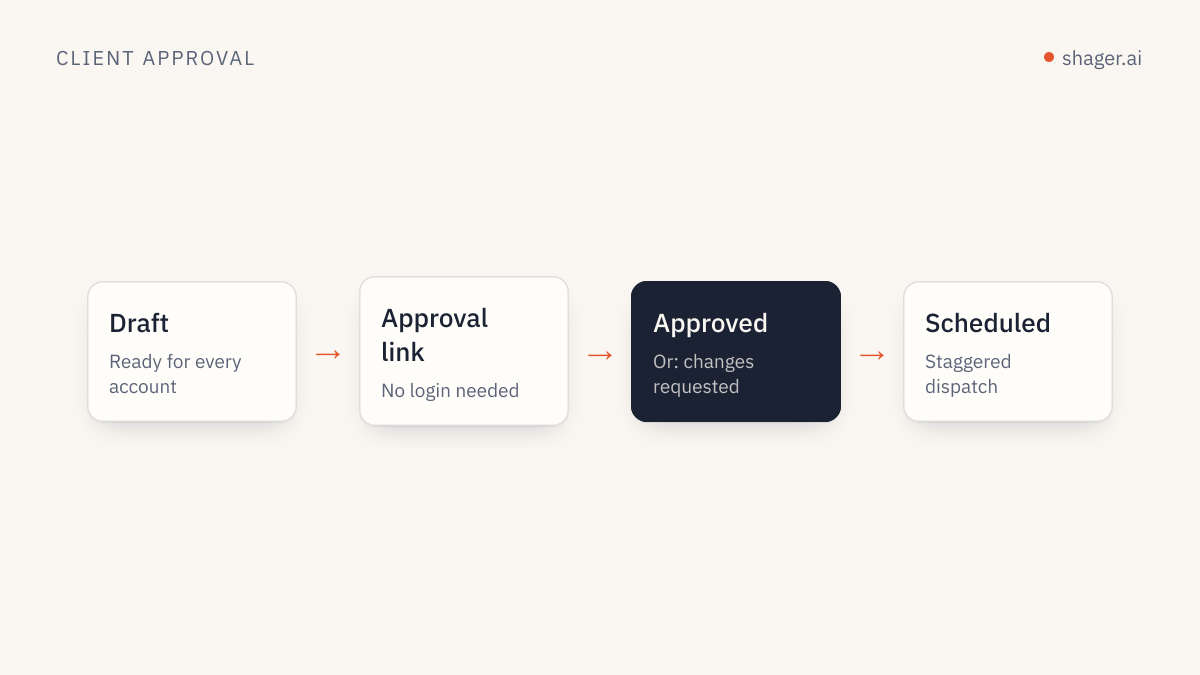
The key move: the client approves the template and the direction, not each of fifty variations. That saves days and puts consistency where it matters most.
Pre-launch checklist for a multi-account campaign
- A short style guide is available inside the tool where posts are written
- Message and CTA are approved at campaign level
- At least two openings and three body variations exist
- Accounts are grouped by audience or region
- Local details (city, address, phone) are checked against a reliable source
- Captions are adapted per network
- A sample from each group has been reviewed before scheduling
- Someone owns comment monitoring on launch day
Wrapping up
A consistent voice across dozens of accounts doesn't come from publishing the same text over and over. It comes from clear decisions documented where people write, templates that leave room for variety, and review focused on what actually matters. An agency that sets this up once saves hours of corrections on every campaign after.
Shager is built for this kind of work: account groups so you write one variation per audience, an AI writing assistant that follows your instructions, and client approval links that show the campaign to the client before it goes out to every account.