No Content, No Existence: Why Silent Brands Vanish When Agents Choose
When agents and answer engines decide what people see, they draw on what is published and findable. A brand that doesn't publish consistently isn't found.
7 min read
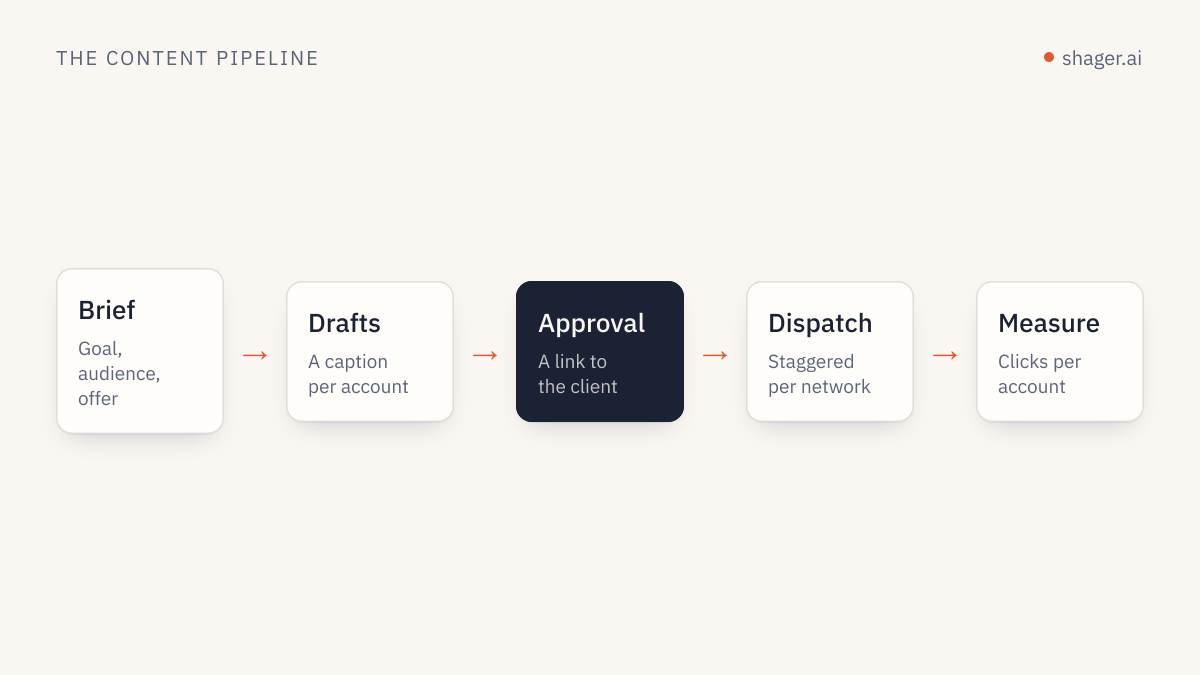
When AI agents and answer engines decide what people see, they can only work with what has been published and can be found. A brand that does not publish consistently gives them nothing to retrieve, cite or recommend, so in practical terms it does not exist for that buyer. Consistent publishing is no longer a marketing nice-to-have; it is the cost of being present at all.
That is a strong claim, so this piece makes the argument carefully, separates what is documented from what is inference, and ends with a working plan for agencies whose clients have gone quiet.
What has changed about how people find businesses?
For twenty years, discovery meant a list of links and a human choosing among them. A brand with a decent website and a few reviews could get by publishing rarely, because the person searching would scroll and click.
Two shifts compress that. Search engines now answer questions directly. Google's documentation on AI features and your website explains that AI Overviews and AI Mode show supporting links, and that to be one of them a page must be indexed and eligible to appear in Search with a snippet. Second, people increasingly hand the search itself to an assistant: "find me three physiotherapists near the office who handle running injuries." The assistant reads, filters and returns a short answer.
In both cases a machine assembles the shortlist before a human sees anything. The shortlist is built from material that exists. That is the whole mechanism, and it is unforgiving.
Why does silence now cost more than it used to?
A shortlist of three is harsher than a page of ten. When a person scrolled, a weak presence still got an occasional click. When an engine or agent summarizes, it tends to lean on sources that are clear, current and specific to the question. A brand whose last post is from February and whose site says little about what it actually does is easy to leave out.
There is no published formula that says "post this often and you will be cited." Anyone quoting one is guessing. What Google does say plainly is that the best practices for SEO remain relevant for AI features and that there are no special optimizations required. Read that the other way round: there is no trick that substitutes for having useful, indexable material. The only lever is publishing it.
Is this an argument for publishing more of anything?
No, and this is where many teams misread the moment. Google's spam policies define scaled content abuse as generating many pages primarily to manipulate rankings rather than help users, "no matter how it's created." Meta's spam policy targets very high frequency posting, manual or automated, and repetitive content. YouTube's spam, deceptive practices and scams policies cover repetitive and untargeted posting.
So the thesis has a second half. Silence makes a brand invisible, and noise makes it untrustworthy. What gets found is steady, specific, varied content tied to real offerings, published where the audience and the engines can see it.
What "consistent" means in practice
For a local or multi-location business, consistency has three dimensions:
| Dimension | What it looks like | What breaks it |
|---|---|---|
| Rhythm | A predictable weekly floor of posts per account | Bursts before campaigns, silence after |
| Coverage | Every location's account is active, not just the flagship | Thirty Pages, five of them alive |
| Specificity | Posts name the service, place, price range or problem solved | Generic stock captions |
Coverage is the one agencies underrate. A dental group with twenty clinics may run a strong main Page and leave nineteen local Pages untouched since launch. Someone searching for a dentist in one of those neighborhoods meets a dead Page. Each of those accounts is a separate surface where the brand either shows signs of life or does not.
Why agents make consistency affordable
The reason clients go silent is rarely strategy. It is labor. Keeping twenty accounts alive every week with captions written for each location is many hours of tedious work, and it is the first thing cut when the team is busy.
That labor is exactly what an agent with access to a distribution platform does well. Our piece on why agents should run distribution makes the full case. The short version: a human sets the monthly themes and approves, and the agent turns them into account-specific posts on a steady schedule.
A plan to bring a quiet client back to life
- Audit the surfaces. List every account and the date of its last post. The agent can do this with
list_channelsandlist_postsfor the client workspace. - Set a floor, not a ceiling. Agree with the client on a minimum weekly rhythm per account that the team can sustain for a year.
- Build a content bank by theme. Services, local proof, seasonal questions, team, process. Each theme produces material for many weeks.
- Let the agent localize. For each post, the agent writes per-account captions with
per_channel, naming the neighborhood or service line that account serves. - Gate with approval. Drafts go to the client through
request_approval, which they can answer without logging in. Our approval workflow guide covers how to set expectations. - Measure per account. Every post carries a per-account short link and UTM tag, and
get_analyticsreturns clicks per account and per post. Dead accounts that stay dead after two months tell you something about the audience, not the effort.
A prompt for step 4 might read:
Workspace "Lakeside Dental". Theme this week: sensitive teeth in cold weather.
Create one FEED post for the group "All clinics" with the attached image.
For each clinic, write a 50 to 80 word caption that names the clinic's
neighborhood and its booking hours. Same core advice everywhere, different
opening and closing lines. Booking link in first_comment.
Draft only. Then call request_approval and give me the approval link.
What this means for agencies
The agency pitch used to be reach. Increasingly it is presence: making sure that when a person or an agent goes looking, the client is there, current and clearly described. That is a retainer worth paying for, and it is one that agents make profitable to deliver across many accounts. The agent entry point shows how to connect one.
FAQ
Does posting on social media help a brand appear in AI answers?
There is no official statement that social posts feed any specific answer engine, so be careful with anyone who promises it. What is documented is that search AI features draw on indexed, eligible pages, and that the usual SEO practices apply. Consistent publishing across your site and public profiles increases the amount of current, specific material available to be found.
How often should a business post to stay visible?
No network or search engine publishes a number. Pick a rhythm per account the team can sustain all year, keep it steady, and judge it by the clicks and leads each account produces rather than by volume.
Is AI-written content penalized?
Google's guidance on using generative AI content says the problem is generating many pages without adding value, and that AI output should be fact-checked before publishing. The test is usefulness, not the tool.
If one of your clients has gone quiet, start with the audit in step 1. It takes an agent a few minutes and usually makes the case to the client better than any deck.