Why AI Agents Should Run Social Distribution, and What Humans Should Keep
Distribution is repetitive, rule-bound work across many accounts, which makes it a natural job for AI agents. Here is what to hand over and what humans keep.
7 min read
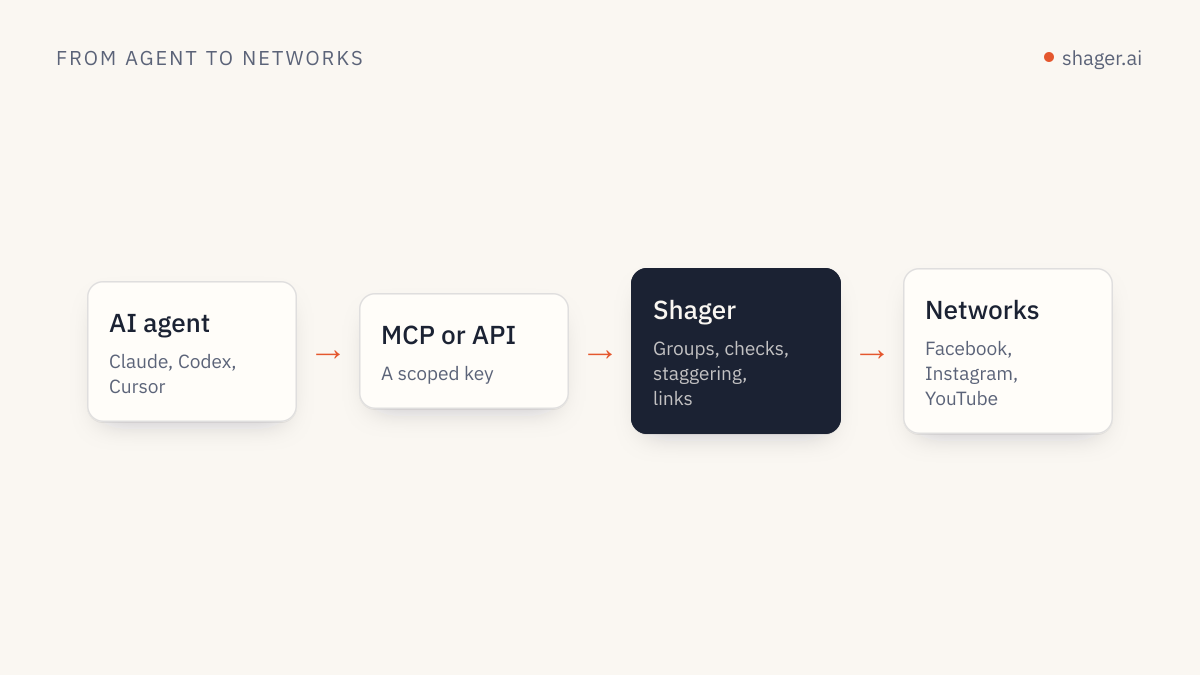
AI agents should run social distribution because most of it is structured, repetitive work with clear rules: picking accounts, adapting captions, timing posts, attaching links and reporting clicks. Humans should keep the decisions that carry judgment and liability, which means strategy, the creative itself and the final approval. Split the work along that line and an agency can serve far more accounts without the quality dropping.
That split sounds obvious, yet most teams still do the opposite. A strategist spends Tuesday afternoon copying one caption into thirty-two Page composers, while nobody has time to ask whether the campaign is pointed at the right audience. The rest of this piece explains why the work belongs to agents now, how to divide it, and what a working setup looks like.
What is distribution work, once you take the creative out?
Take a single campaign for a client with forty locations. The video is done and the message is approved. What remains looks like this:
| Task | Nature of the work | Who should own it |
|---|---|---|
| Choose which accounts get the post | Rule-based, from account groups | Agent |
| Adapt the caption per account | Pattern work inside fixed constraints | Agent, with human-set rules |
| Check format limits per network | Mechanical | Agent and platform |
| Set the schedule and spacing | Rule-based | Agent |
| Attach a tracked link per account | Mechanical | Platform |
| Decide whether the post goes out | Judgment and accountability | Human |
| Read the results and change course | Judgment | Human, with an agent's summary |
Five of seven rows are work a person does slowly and a model does well. None of them require taste. They require patience, consistency and a memory for rules, which is where people get tired and agents do not.
Why now and not three years ago?
Two things changed. Models became reliable at following detailed written instructions across long tasks, and a common way for them to act on outside systems arrived. The Model Context Protocol describes itself as an open standard for connecting AI applications to external systems, and it is supported by clients such as Claude, ChatGPT, Cursor and Visual Studio Code. Before that, every integration was a one-off script that broke when someone changed a field name.
With a standard in place, a distribution platform can expose its operations as tools, and any capable agent can use them. If MCP is new to you, our plain-language explainer for marketers covers it without the jargon.
Why agents are better at this specific job than people
The case is not that agents are smarter. It is that distribution punishes inconsistency, and consistency is cheap for software.
A human scheduling posts across sixty accounts will, at some point, paste the wrong link into the wrong Page, forget the first comment on account forty-one, or schedule two client Pages at the identical minute. None of these are skill problems. They are attention problems that grow with volume.
An agent working through a defined tool set does the same steps in the same order every time. It reads the account list from the platform instead of from memory. It writes a different caption for each account because the instructions say so, not because it remembered. And when the platform rejects something, it gets a structured error back and can fix it without a human noticing the problem first.
What humans should keep, without exception
Handing distribution to an agent is not handing over the brand. Three things stay with people.
First, strategy. Which audience, which offer, which month. An agent can draft options; it should not pick the quarter's direction.
Second, the creative claim. Anything that makes a promise about price, health, finance or results needs a human who will answer for it.
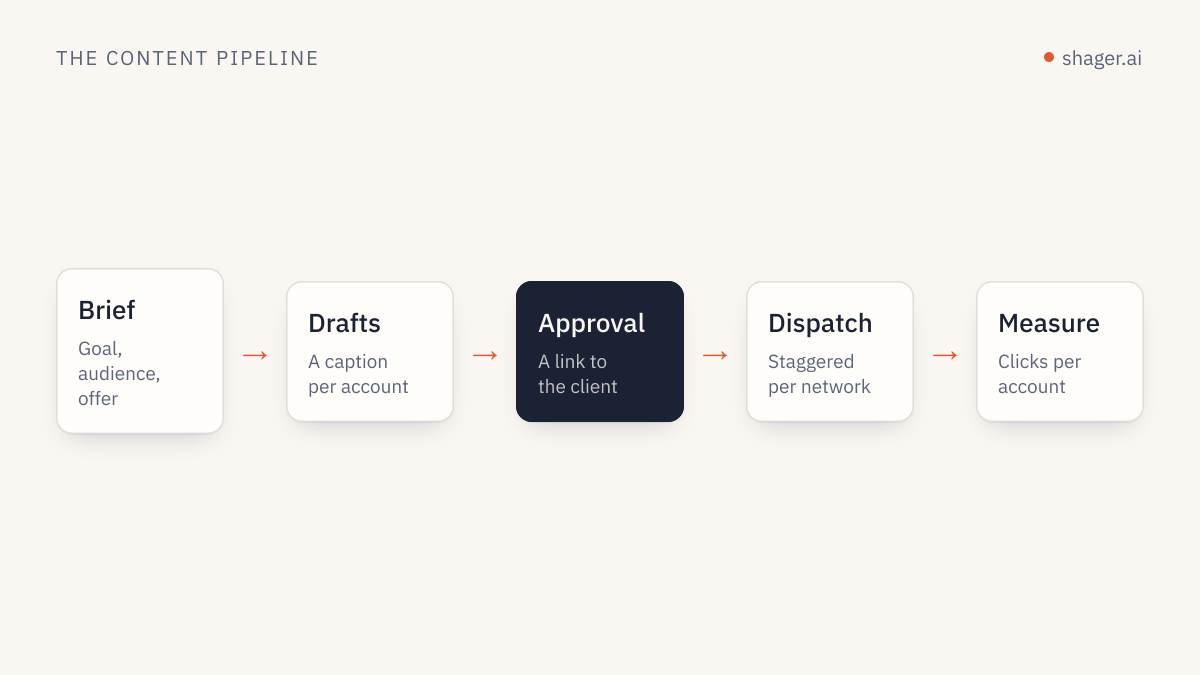
Third, the publish decision. The MCP specification itself says that for trust and safety there should always be a human in the loop with the ability to deny tool invocations. In practice that means drafts by default and a deliberate step before anything goes live. We go deeper on where to place that gate in human approval for agent posts.
A working setup in six steps
This is the sequence we recommend for a team starting out with Shager as the distribution layer.
- Connect the agent. Point an MCP client at
https://app.shager.ai/api/mcpwith an API key in theAuthorizationheader. The agent entry point lists the setup for each client. - Start in drafts. Give the first key
readandwritescopes only. The agent can build posts but cannot schedule or publish them. - Group the accounts. Create account groups that match how the client thinks: regions, brands, languages. The agent targets groups, not forty separate IDs.
- Write the rules once. Put the caption constraints, banned phrases, link rules and timing windows in a skill or system prompt, not in each request.
- Review a week of drafts. Read what the agent produced. Fix the rules, not the posts.
- Add the publish scope. Only after the drafts are consistently right does a human issue a key with
publish.
What the agent's run looks like
Here is a prompt a strategist might give the agent on a Monday morning:
Client: Harbor Fitness, workspace "Harbor Fitness".
Video: https://cdn.example.com/harbor/sept-open-house.mp4 (1080x1920, 28s).
Post it as a Reel to the "Studios North" group on Thursday 18:00 local time.
Write a different caption for each studio using its neighborhood name.
Lead link in the first comment: https://harborfitness.example/open-house
Create drafts only and send me the list for review.
And the tool sequence the agent runs against Shager's MCP server:
whoami                     confirm key, scopes and organization
list_workspaces            find "Harbor Fitness"
list_groups                find "Studios North"
list_channels              read channel names to personalize captions
upload_media_from_url      url, file_name, width 1080, height 1920, duration_ms 28000
create_post                caption, group_ids, media_ids, format "REEL",
                           first_comment, cta_url, per_channel[...],
                           stagger_seconds [60, 180], no schedule_at (draft)
list_posts                 return the drafts for human review
Nothing here goes live. The human reads the drafts, then either approves the schedule or sends them to the client with request_approval. Once the key has the publish scope, schedule_post puts them in the calendar, and Shager checks each post against the target network's rules before sending and dispatches with spacing between accounts.
Where this goes wrong
Teams that struggle with agent-run distribution usually make one of three mistakes. They give the first key full publish rights, so the first bad prompt becomes a public post. They let the agent post identical captions everywhere, which looks like spam to people and to platforms. Or they skip measurement, so nobody can tell whether the extra volume produced anything. Each has a fix covered elsewhere in this series, starting with safety rules for agents posting at scale.
FAQ
Does an agent replace the social media manager?
No. It replaces the copy, paste and schedule part of the role. The manager's time moves to strategy, client conversations and reviewing what the agent produced, which is the part clients actually pay for.
Which AI clients can run distribution through Shager?
Any client that can connect to a remote MCP server over Streamable HTTP with a bearer token header, which includes Claude Code, Claude Desktop, Codex and Cursor. Clients that only support OAuth connectors need to wait for OAuth sign-in, which is coming, or call the REST API from code.
Can an agent publish without a human ever being involved?
Technically a key with the publish scope can schedule posts directly. We recommend against it for client accounts. Keep drafts as the default, and let a human or the client approve before anything is scheduled.
The practical next step is small: connect one agent to one client workspace in draft mode and let it prepare next week's posts. The agent entry point has the connection details, and an agent can register itself through /auth.md before a human claims the sandbox.