The Agency Operating Model When AI Agents Handle Distribution
How a social agency restructures roles, weekly rhythm, client workspaces and API keys when AI agents do distribution and people own strategy and approval.
8 min read
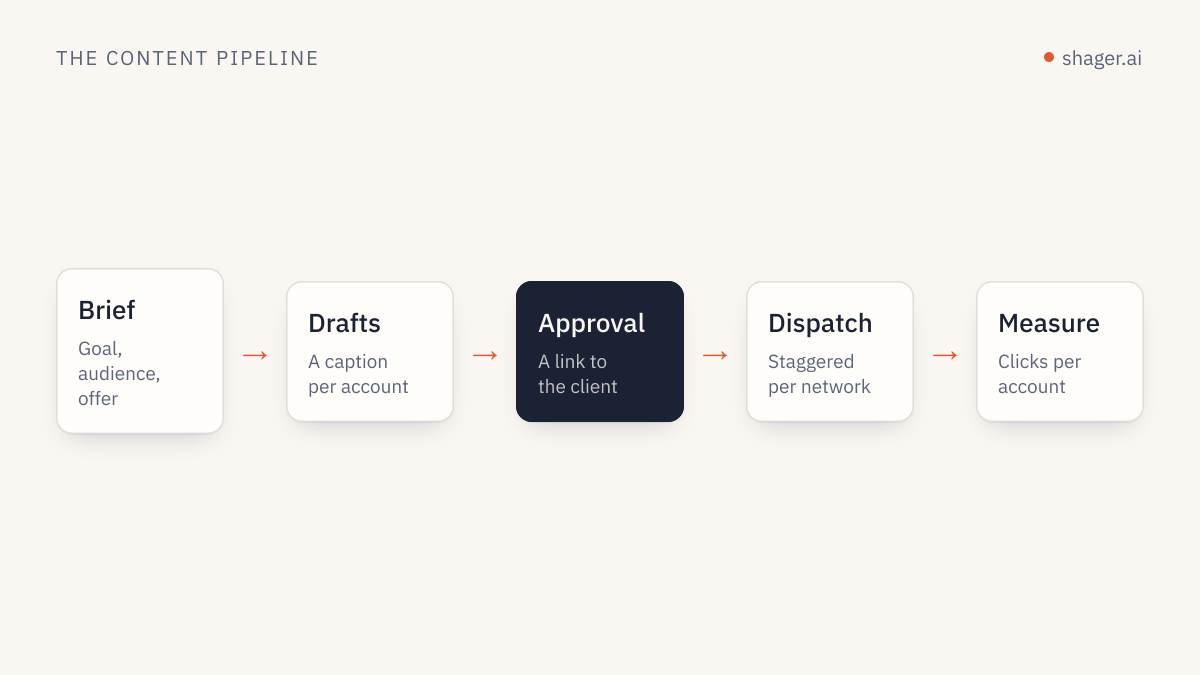
An agency that uses AI agents for distribution should reorganize around three human roles, strategist, editor and client lead, plus one technical owner who runs the agents. Agents take the production line between an approved idea and a scheduled post across many accounts. People own direction, quality and the client relationship, and the weekly rhythm is built so that every agent output passes a human before it goes live.
Most agencies bolt an agent onto the old structure and wonder why nothing improves. The old structure assumed that the scarce resource was hands. Once the hands are cheap, the scarce resources are judgment and review time, and the model has to be designed around those.
What changes when production stops being the bottleneck?
In a traditional social agency, account managers spend most of their week on production: writing variants, uploading, scheduling, chasing links, building reports. Their capacity sets how many accounts the agency can carry.
With an agent connected to a distribution platform, production for one campaign across fifty accounts becomes a single instructed run. The constraint moves upstream to "is the idea good and approved?" and downstream to "did anyone read the results?" If you do not staff those two points, the agency simply produces more mediocre posts faster.
Which roles does the agency need?
| Role | Owns | Spends time on | Does not do |
|---|---|---|---|
| Strategist | Monthly themes, offers, audiences per client | Planning, reading results, client strategy calls | Writing per-account captions |
| Editor | Quality of agent output | Reviewing drafts, refining the agent's rules | Scheduling by hand |
| Client lead | The relationship and approvals | Sending approval links, handling feedback | Production |
| Agent operator | Keys, skills, prompts, audit | Maintaining the agent setup across clients | Content decisions |
In a small agency one person may hold two of these. The point is that each responsibility has a name attached. The agent operator role is new for most teams and is often missing, which is why prompts drift and nobody knows which key can publish where.
How should client accounts be structured?
Structure decides what an agent can and cannot touch by accident.
- One workspace per client. Each client's accounts live in their own workspace. An agent working on Client A never sees Client B's channels in the same list.
- Groups that mirror the client's org chart. Regions, brands, languages, franchise tiers. The agent targets
group_ids, and the strategist can reason about "all northern stores" without a spreadsheet. - Client-owned connections. Clients connect their own Facebook, Instagram or YouTube accounts through a connect link, so no passwords pass through the agency. See client connect links for the full flow.
- Keys scoped to the job. A drafting agent gets
readandwrite. Only the step that schedules getspublish. Every call shows in the audit log on the agents dashboard, which our article on API keys, scopes and audit walks through.
If you operate one agent across many clients, the separation matters even more. Our guide to running one agent for many clients covers the prompt and key patterns that keep work from crossing over.
What does the weekly rhythm look like?
Here is a rhythm that works for agencies running between ten and a few hundred accounts. The days are illustrative; the order is what matters.
- Monday, planning. The strategist writes a one-page brief per client: theme, offer, assets, which groups, which days, and any claims that need legal care.
- Monday afternoon, agent run. The agent operator triggers the run. The agent uploads media, writes per-account captions and creates drafts.
- Tuesday, editorial review. The editor reads every draft batch. Problems are fixed in the agent's rules, then the run is repeated, so the same issue does not come back next week.
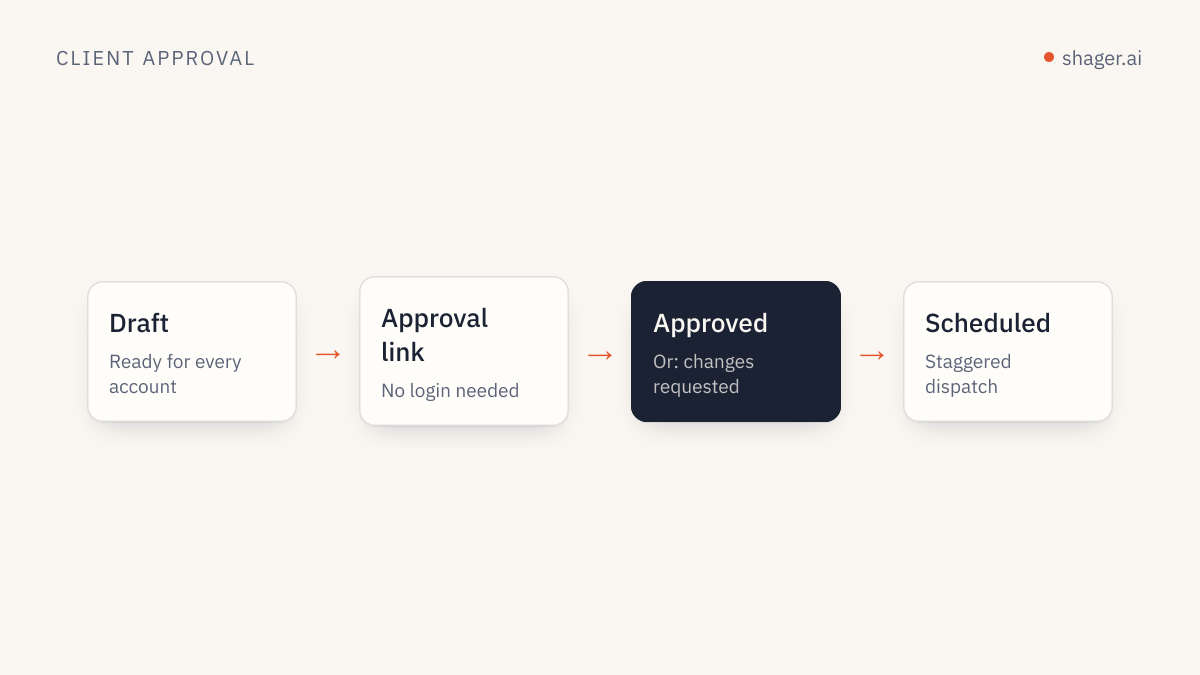
- Tuesday afternoon, client approval. The client lead sends approval requests. Clients approve without logging in.
- Wednesday, scheduling. Approved posts are scheduled with staggered dispatch across accounts.
- Friday, reading results. The agent pulls clicks per account and per post, writes a short summary, and the strategist decides what changes next week.
The brief in step 1 is the most important artifact in the whole system. A vague brief produces vague posts at scale.
What does the agent run on Monday look like?
The agent operator usually keeps the run instructions in a skill so they are the same every week. A weekly instruction to the agent can be short because the rules live elsewhere:
Run the weekly distribution routine for workspace "Northwind Bakeries"
using brief 2026-W38 (attached).
Groups: "City stores", "Mall kiosks".
Formats: REEL for the video, FEED for the two photos.
Draft only. When done, request approval for all drafts and return the links.
The tool calls behind that instruction:
whoami                    check scopes: expect read, write
list_workspaces           select "Northwind Bakeries"
list_groups               resolve "City stores", "Mall kiosks"
list_channels             fetch account names for localization
upload_media_from_url     once per asset, with width, height, duration_ms for the Reel
create_post               per asset: caption, group_ids, media_ids, format,
                          per_channel[...], first_comment, cta_url,
                          campaign "w38-autumn-menu", label "agent-draft"
request_approval          per post, returns a link for the client
The campaign and label fields look like housekeeping, but they are what make Friday's reporting possible without anyone tagging posts by hand. If you want the routine itself packaged as a reusable skill, see the weekly distribution routine.
How should the agency price this?
Pricing per post makes little sense once posting is cheap. Most agencies that move to this model price per account under management, with the strategy and reporting as the core of the retainer. On the platform side, Shager prices by connected accounts and includes API access, MCP and unlimited users on every plan, so adding an agent or a reviewer does not add seats. The current tiers are on the pricing page.
What are the common failure modes?
The first is skipping editorial review because "the agent is good now." Drift is gradual. A weekly read catches it early.
The second is letting every team member run their own prompts. Two people instructing the same agent differently for the same client is how brand voice falls apart. Keep one skill per client and change it deliberately.
The third is never reading Friday's numbers. If nobody acts on per-account results, the agency is producing volume, not outcomes.
FAQ
How many accounts can one editor review per week?
That depends on post length, the number of variants and how mature the agent's rules are. Early on, review takes longer because you are still fixing the rules. Track review hours per client for the first month and set capacity from your own data.
Should clients know an agent writes their captions?
We recommend telling them. Explain that an agent drafts and a named editor reviews before anything reaches them for approval. Most clients care about quality and accountability, and this model gives them both.
Do we need a developer to run this?
No. The agent operator needs to be comfortable with API keys and editing a skill file, not writing software. The MCP connection is configuration, not code.
A good first move is to pick one mid-sized client, set up the workspace and groups, and run the Monday to Friday rhythm for two weeks before changing anything else.