Brand Marketing vs. Lead Generation: How an Agency Builds Both at Once
Why a lead-gen agency needs brand content too: how to split the calendar, how to measure each track, and how to show the client it pays off.
Most clients come to a lead-generation agency with one request: more enquiries, at a lower cost. It's a fair ask, and it's what they're paying for. But an agency that answers it with nothing except "leave your details" posts usually finds, a few months in, that results are wearing thin. The audience has seen the offer, cost per lead is creeping up, and the pages read like a classifieds board.
This article is about working brand content into lead-generation work without losing focus on the number the client actually measures.
Two different jobs for the same feed
Lead generation speaks to people who are ready to act now. The message is direct, there's an offer and a call to action, and success is counted in enquiries.
Brand marketing speaks to everyone else: people who don't need the service yet, people who need it but haven't heard of you, and people who know you but don't trust you yet. The message is broader, and the goal is that when the moment comes, your client's name is the first one that comes to mind.
The catch is that at any given moment, only a small slice of the audience is ready to act. An agency that talks only to that slice is always competing for the same small group, and paying more for it every quarter.
Why lead posts on their own wear out
A few patterns show up again and again at agencies that run nothing but direct-response posts:
- Offer fatigue: the same promotion, in the same words, week after week. The audience stops seeing it.
- Low trust: a page where every post asks for something gives people no reason to believe it.
- Colder leads: people who leave their details without knowing the business are less likely to pick up the sales call.
- Total dependence on paid spend: without an organic audience that knows the brand, every lead has to be bought.
There's no single benchmark that holds across industries, so check this against your own clients. But if you recognise these patterns, a brand component is probably missing.
What brand content looks like at a lead-gen agency
Brand content doesn't have to mean an expensive brand film. For local businesses and service companies, it's usually much simpler:
- People: who answers the phone, who comes to the house, who handles the case
- Behind the scenes: what a working day looks like, how the service actually gets done
- Expertise: a tip, a common mistake, an answer to the question customers ask every week
- Real proof: a finished project, a before and after, with the end customer's permission
- Local presence: an event in town, a collaboration with a neighbouring business
What these have in common is that they don't ask for anything. They give the audience a reason to remember and to trust.
Splitting the content calendar
There's no single right ratio. It depends on the industry, the length of the sales cycle and how well the audience already knows the brand. A reasonable starting point to test:
| Content type | Job | Example |
|---|---|---|
| Brand | Familiarity and trust | Meet the team at the downtown branch |
| Value | Useful knowledge | Three questions to ask before you choose a supplier |
| Proof | Credibility | A project we wrapped up this month |
| Lead | Action | An offer with a link to leave your details |
Start with a split where a meaningful share of posts are not sales posts, then adjust based on results. What matters is that the split is planned, not the side effect of "we had nothing to post this week."
At the scale of dozens of accounts
When you publish to many branches or locations, brand content is also the most natural way to vary the feed. A lead post from a national campaign will look much the same on every branch page, but a post introducing one branch's team is original by definition. That helps the audience, and it helps distribution.
How to measure each track
The most common mistake is judging brand content by direct leads and concluding that it "doesn't work."
Metrics for lead content
- Link clicks, per account
- Leads that reached the CRM, attributed to an account and a campaign
- Cost per lead, and lead quality according to feedback from sales
Metrics for brand content
- Reach and engagement over time, not per individual post
- Growth in followers and returning viewers
- Branded search volume, if you have access to that data
- Change in the conversion rate of lead posts over several months
That last metric is where the two tracks meet. If, after a few months of brand content, lead posts on the same accounts convert better, that's the sign the combination is working.
How to present it to the client
A client paying for leads will rightly be suspicious of any post that doesn't bring in enquiries. A few ways to build trust in the approach:
- Present it as part of the strategy from day one, not as an excuse once leads dip
- Commit to the same lead target, and explain that brand content is there to sustain it over time
- Report on the two tracks separately, so the client can see what each one contributes
- Run a test: one group of accounts with the mix, one without, and compare after a reasonable period
Checklist for a calendar that combines brand and leads
- A planned split between content types is set for each client
- There's a bank of brand ideas for every account or branch
- Brand content includes local details and real people
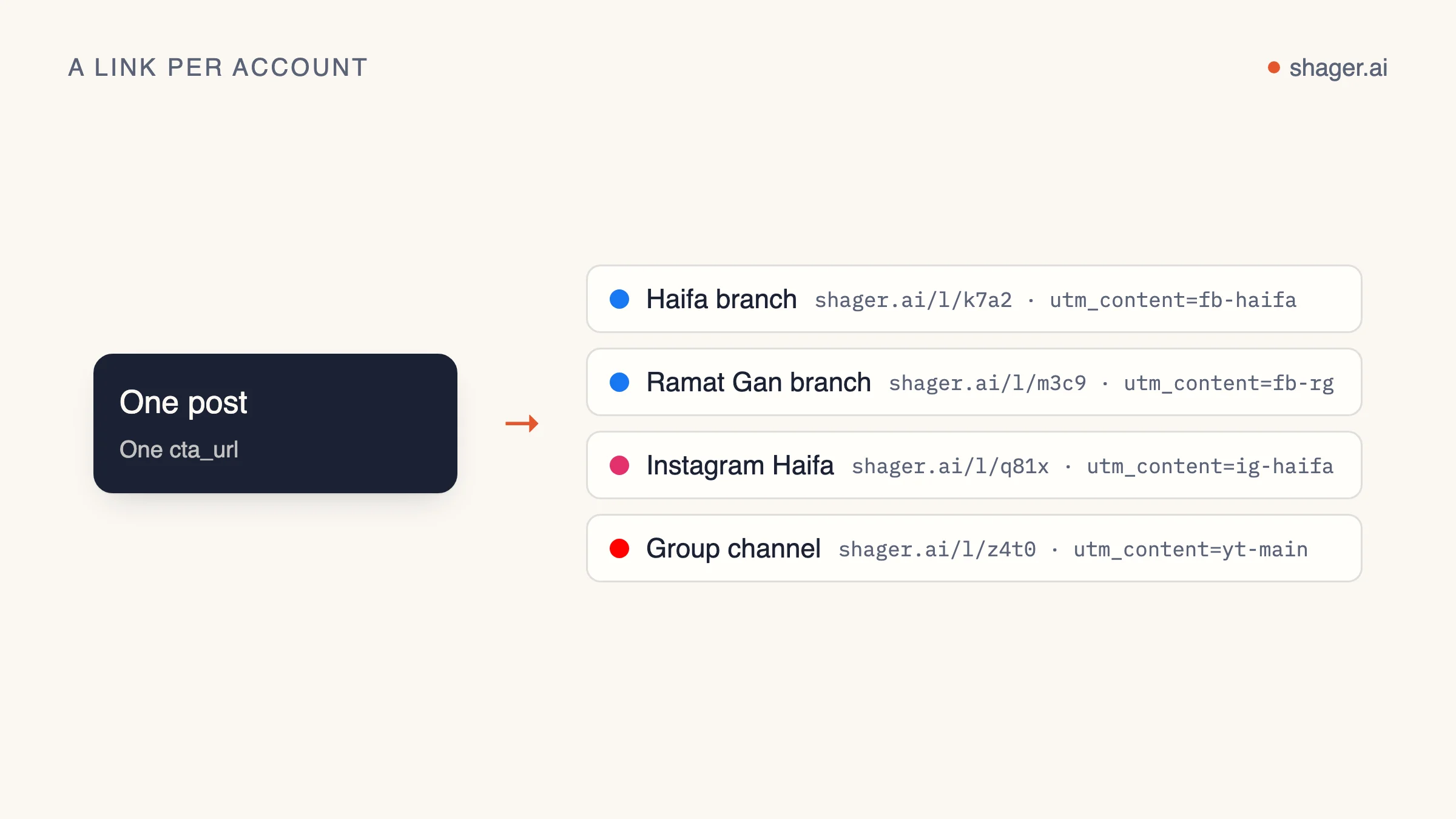
- Every lead post has its own UTM tags and link per account
- Brand content is measured on its own metrics, over time
- The client knows in advance why some posts don't ask for details
- There's a plan to test whether the mix improves conversion
Wrapping up
Brand marketing and lead generation aren't competing strategies. They're two parts of the same machine: one builds the audience and the trust, the other turns them into enquiries. An agency that runs both together gives its clients results that don't fade after a quarter, and keeps clients who stay.
Shager helps you run both tracks on one calendar: account groups that let you plan local brand content alongside national campaigns, UTM tags and short links that measure the leads from each account, and an AI writing assistant that helps produce both kinds of content in each client's voice.